How to Brand a Fleet of Vehicles: What Indianapolis Business Owners Need to Know
Start With a Brand Standard
What to Lock Down
Logo versions — Which version of your logo appears on vehicles? Full color, reversed, single color? Make sure you have high-resolution files for each.
Colors — Specify your brand colors in CMYK and Pantone values so your print partner can match them accurately every time, regardless of which vehicle or when it’s produced.
Fonts — If you use specific typefaces, your designer needs the font files or equivalent specifications.
Minimum sizes — Define how small your logo can appear before it loses legibility. This matters when adapting designs for smaller vehicles or panels.
What Can Flex
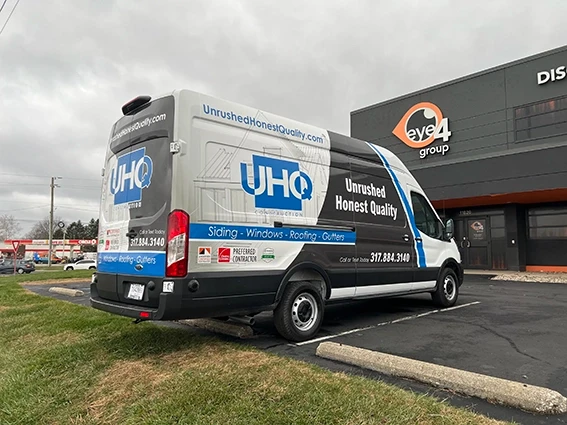
Not everything needs to be identical. Layout can adapt to fit different vehicle shapes as long as the core brand elements — logo, colors, and key message — remain consistent. A cargo van and a sedan will never look exactly the same, but they should look like they belong to the same company. If you don’t have a formal brand guide yet, Eye 4 Group’s design and branding team can help you establish one before the first vehicle is wrapped.
Designing for Different Vehicle Types in Your Fleet
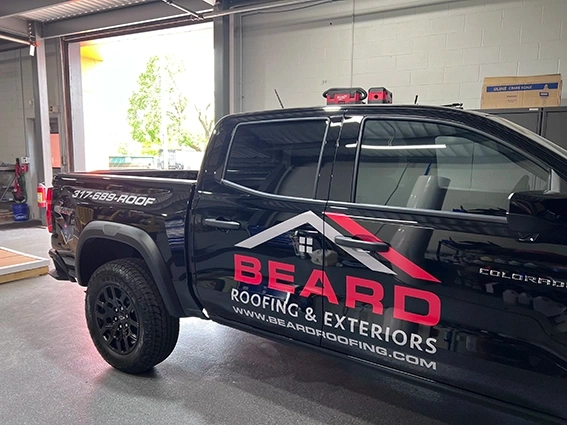
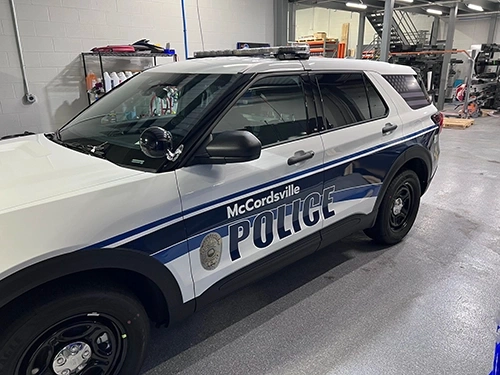
One of the most common mistakes in fleet branding is creating a single design and expecting it to work on every vehicle. It rarely does. A layout that looks great on the flat side panels of a cargo van may not work at all on the curved surfaces of a pickup truck or the smaller canvas of a compact sedan.
Account for Body Lines and Physical Features
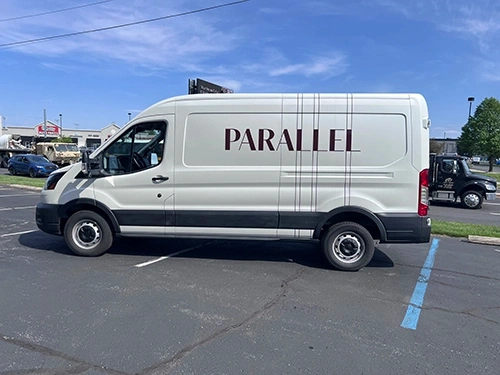
Door handles and locks — Graphics that run through door handles look unfinished. A good designer plans around them.
Wheel arches — Text or logos that wrap around wheel arches distort unless the design accounts for the curve.
Windows — Solid vinyl cannot go over windows without using perforated material. Design needs to treat glass and body panels differently.
Body lines and creases — Sharp body lines on modern vehicles can break up text or images if they’re not positioned carefully.
Build a Design System, Not Just a Single Design
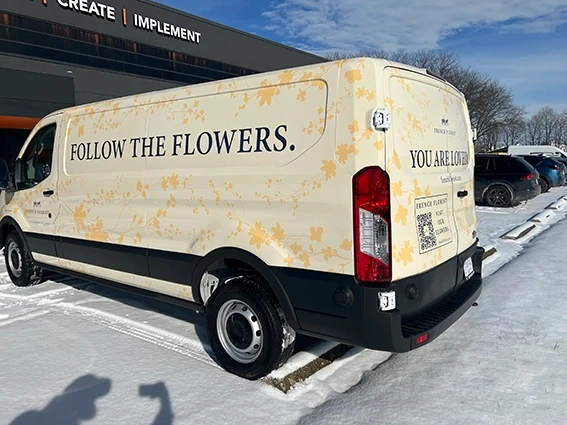
Rather than one rigid layout, think of your fleet graphics as a design system — a set of rules and templates that adapt to each vehicle type while keeping core brand elements consistent. This approach makes it much easier to add new vehicle types later without starting from scratch. When you work with Eye 4 Group for your fleet graphics in Indianapolis, the design team creates vehicle-specific mockups for each type in your fleet before anything goes to production, so you can see exactly how the design will look on each vehicle.

What Information to Include — and What to Leave Off
Every square inch of your vehicle is potential advertising space, but that doesn’t mean you should use all of it. The vehicles that generate the most impressions and the best recall are almost always the ones with the clearest, most focused messaging.
What to Include
Company name and logo — Always, on every vehicle, on multiple sides.
Phone number — A local Indianapolis number is worth including if it’s memorable. People stopped next to you at a red light can read it, repeat it out loud, and call it later.
Website URL — Useful on the rear of vehicles where drivers behind you have time to read it at a stop. Keep it short — a subdomain or landing page URL works better than a long address.
Tagline or one-line service description — If what you do isn’t obvious from your company name, a short descriptor helps. “Custom Signs & Graphics” or “Indianapolis HVAC” does the job.
What to Leave Off
Long service lists — If you offer ten services, resist the urge to list all ten. Pick the one or two that matter most to your target customer.
Social media handles — Rarely practical on a vehicle. People can’t write them down at speed, and they take up valuable space.
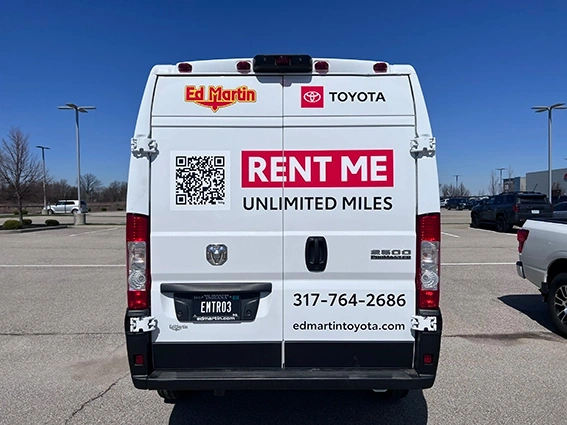
QR codes — Only work when someone is stationary and has their phone out. Not worth the real estate on most fleet vehicles.
Too many contact options — Pick one primary call to action, whether that’s a phone number or a website. Multiple options create indecision.
The Production and Installation Process for Multiple Vehicles
Getting fleet graphics produced and installed across multiple vehicles requires coordination that single-vehicle projects don’t. Understanding the process upfront helps you plan around it.
Proofing and Approval
Scheduling Installs to Minimize Downtime
Quality Checks Across the Fleet
Once installation is complete, review all vehicles side by side where possible. Color consistency, panel alignment, and finish quality are much easier to spot when vehicles are compared directly. Flag anything before signing off — a reputable installer will address it.
Large Quantitites
Managing Replacements and Additions as Your Fleet Grows
Fleet graphics are a long-term investment, but fleets change over time. Vehicles get damaged, replaced, or added. Planning for this from the start saves significant headaches later.
Keep Your Design Files Accessible
Make sure you have copies of all finalized design files — ideally in the original editable format, not just print-ready PDFs. Store them somewhere your team can access them, not just on one person’s laptop. You’ll need them when a vehicle is replaced or damaged and you need to reproduce a graphic quickly.
Document Your Specs
Record the exact materials, laminates, and color specifications used on your fleet. This makes it much easier to match graphics accurately when adding new vehicles years later, even if materials or suppliers have changed slightly.
Plan for Panel Replacements
If a single vehicle panel is damaged, you shouldn’t need to rewrap the entire vehicle. A panel replacement is straightforward when your files and specs are well documented. Without them, matching the original graphic becomes a guessing game that often results in a visible mismatch.
Getting Your Fleet Branded in Indianapolis
Eye 4 Group handles the full process for fleet vehicle graphics in Indianapolis — from initial design and vehicle-specific mockups through to production and installation. Everything is done in-house, which means consistent quality across every vehicle and no gaps between design, print, and install.
Whether your fleet is two vehicles or twenty, the process starts with understanding your brand, your vehicles, and your goals. From there, the design team builds out a system that works across your whole fleet — and is set up to scale as your business grows.
Request a free quote or call 317-804-4080 to get started.